
WHOLE-HOME GENERATORS · WASHINGTON
Whole House Generator Cost in Washington (2026 Guide)
The honest, homeowner-first breakdown of what backup power really costs in Washington — what drives the price, where the surprises hide, and how to know you’re being quoted fairly.
Written and reviewed by a licensed Washington master electrician.
THE QUICK ANSWER
Most Washington homeowners pay $16,000 to $24,000 for a whole-house standby generator, professionally installed and inspected. A straightforward installation on a home already served by natural gas can land closer to $16,000; a larger or all-electric home that needs a bigger, liquid-cooled unit — or a panel upgrade — can reach $20,000 to $25,000 or more. The three things that move your price most are the size your home actually needs, your fuel source, and how far the unit sits from your gas and electrical meters.
AT A GLANCE
- Typical installed cost: $16,000–$24,000 for most Washington homes.
- Simple natural-gas install: can land near $16,000.
- Large or all-electric home: $20,000–$25,000+.
- The biggest surprise: installation usually costs about as much as the generator itself.
- What moves the price most: size, fuel source, and distance from your meters.
$16k–$24k
typical installed cost in WA
~50%
of the total is installation, not equipment
600,000+
Western WA homes dark after the Nov. 2024 bomb cyclone
15–30 yrs
a well-maintained unit’s lifespan
Executive summary
A whole-house generator is one of the larger discretionary purchases a homeowner will make, and the price range you’ll see online — anywhere from $7,000 to $25,000 — is wide enough to be almost useless on its own. This guide exists to make that range make sense. Here’s what’s true for most Washington homes in 2026:
- The installed total — not the sticker price of the generator — is the number that matters. Installation typically costs about as much as the equipment itself.
- The generator unit runs roughly $4,500–$7,500 for the air-cooled models that fit most homes, and $8,000–$15,000+ for the liquid-cooled units larger or all-electric homes require.
- Labor and installation add $3,000–$8,000, driven mostly by distance from your meters, gas-line work, and whether your electrical panel needs an upgrade.
- Permits and inspections in Washington are non-negotiable and modest ($100–$400 combined), but involve both a state electrical permit and a local mechanical permit.
- Ongoing ownership — annual service plus fuel during outages — runs a few hundred dollars a year for most homes, and it’s the part of the budget people forget.
EDITOR’S NOTE
We make money only if you eventually ask us to recommend an installer — so you might expect a guide like this to nudge you toward “yes, buy one.” It won’t. Several sections below tell you when a generator isn’t worth it, and how to spend less if you do buy. We’d rather be the page you trust than the page that sold you. That’s a deliberate editorial choice, and it holds for every guide we publish.
What a whole-house generator costs in Washington, line by line
The most honest way to understand the price is to take it apart. Below is a realistic 2026 breakdown for a typical Western Washington home. Your quote should contain most of these lines — and if it doesn’t, that’s worth a question.
| Line item | Typical 2026 range | Notes |
|---|---|---|
| Generator unit — air-cooled (18–26 kW) | $4,500 – $7,500 | Covers the majority of homes |
| Generator unit — liquid-cooled (27 kW+) | $8,000 – $15,000+ | Larger or all-electric homes |
| Automatic transfer switch (ATS) | Often included; $400 – $1,300 standalone | The “brain” that switches your home to generator power |
| Installation labor | $6,000 – $10,000 | The most site-dependent line |
| Concrete or composite pad | $200 – $800 | Frequently bundled into labor |
| Gas / fuel connection | $15 – $50+ per linear foot | Propane adds a tank |
| Electrical permit (WA L&I) + local mechanical permit | $100 – $400 combined | Required; varies by jurisdiction |
| Electrical panel upgrade (only if needed) | $2,000 – $4,000 | Common on older panels |
| Startup, testing & commissioning | Usually included | Confirms the system works before crews leave |
| Typical installed total | $16,000 – $24,000 | Most Western Washington homes |
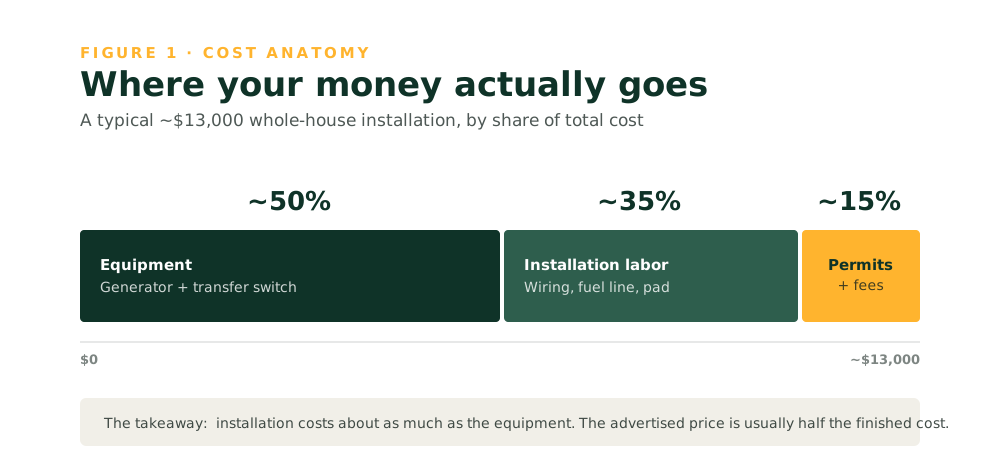
Figure 1. Where your money goes: a typical ~$13,000 installation, by share of cost.
❝ A reliable rule of thumb: installation tends to cost about as much as the equipment. When a price sounds too good, it’s almost always the equipment-only number. ❞
Watch the words “whole house.” At big-box stores, “whole house” often describes the transfer switch capacity (e.g., a 200-amp switch), not the generator’s actual power output. A 200-amp switch paired with an undersized generator will not run your whole house. What protects you is correct sizing for your home’s real electrical load — not a label on a box.
What actually drives your price
Two homes on the same street can receive quotes thousands of dollars apart, usually for good reasons. These are the variables that move the number.
AT A GLANCE
Five things explain almost every price difference: size, fuel, distance from your meters, panel condition, and air-cooled vs. liquid-cooled. The first three are the heavy hitters.
1. The size your home actually needs
Capacity, measured in kilowatts (kW), is the single largest factor in unit price. A home that only needs the furnace, refrigerator, well pump, and a few lights can use a smaller, cheaper unit. A home that wants central air, an electric range, an EV charger, and a home office running at once needs far more capacity — and a more expensive generator. Bigger is not automatically better; the goal is the right size, which is why a reputable installer calculates your load rather than guessing.
2. Your fuel source
Natural gas and propane are the two realistic options in Washington. If your home is already on natural gas, the connection is usually simpler and the running cost lower. Propane — common in rural areas without a gas main — adds a tank and its placement. (Full comparison below.)
3. Distance from your meters
This is the quiet cost driver most homeowners don’t anticipate. The most economical installation is one where the generator sits near both the gas and electrical meters, ideally on the same side of the house. When the meters are far apart, the project takes on longer wiring runs, more conduit, and sometimes trenching — all of which add cost.
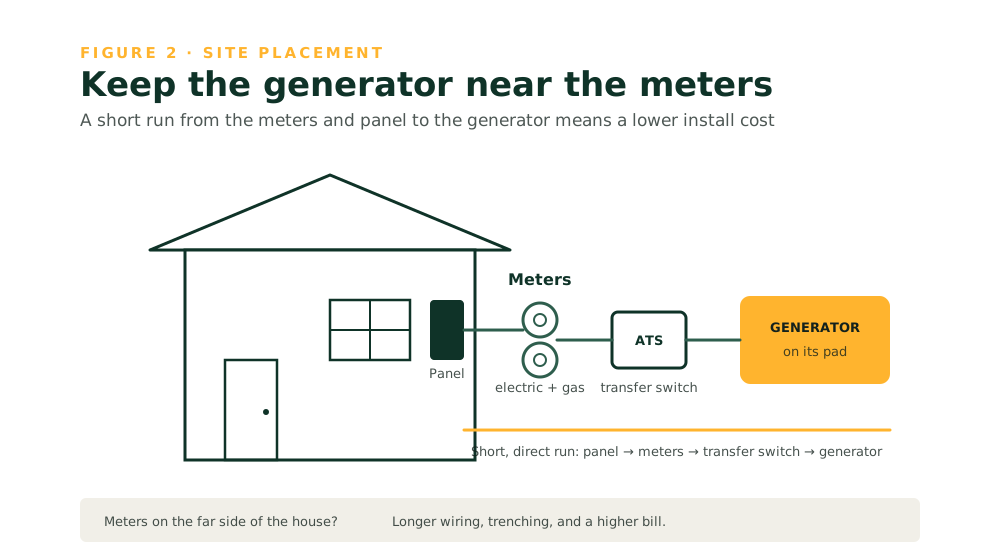
Figure 2. The cheapest install is the shortest one — generator near both meters, transfer switch at the panel.
4. The condition of your electrical panel
If your existing panel is older or near capacity, it may not safely accept a generator connection, and an upgrade becomes part of the job — commonly $1,000–$3,000. This is a frequent surprise on homes built before the 2000s.
5. Air-cooled vs. liquid-cooled
Air-cooled units (the size of an AC condenser) cover most homes and cost less. Homes over roughly 3,000 square feet, or all-electric homes needing whole-home coverage including central air, typically require liquid-cooled generators, which start in the mid-teens and climb.
HEAD TO HEAD — Air-cooled vs. liquid-cooled
Air-cooled — $4,500–$7,500 · up to ~26 kW · most homes · ample for gas-heated homes under ~3,000 sq ft.
Liquid-cooled — $8,000–$15,000+ · 27 kW and up · large or all-electric homes · necessary when running central A/C, an electric range, and an EV charger together.
Choose by load, not square footage alone — an all-electric 2,400 sq ft home can need more than a gas-heated 3,200 sq ft one.
How big a generator does your home need?
Size determines both what you can run and a large share of your cost. Use this as orientation, not a final spec — proper sizing comes from a load calculation by a licensed installer.
| Coverage goal | Typical size | What it generally keeps running | Unit type |
|---|---|---|---|
| Essentials only | 10 – 14 kW | Furnace blower, refrigerator, well pump, lights, internet | Air-cooled |
| Most of the home | 18 – 22 kW | The above, plus parts of the kitchen and some climate control | Air-cooled |
| Whole home (managed) | 24 – 26 kW | Nearly everything, with smart load management | Air-cooled |
| Large or all-electric | 27 – 48 kW | Everything, including central A/C, electric range, EV charging | Liquid-cooled |
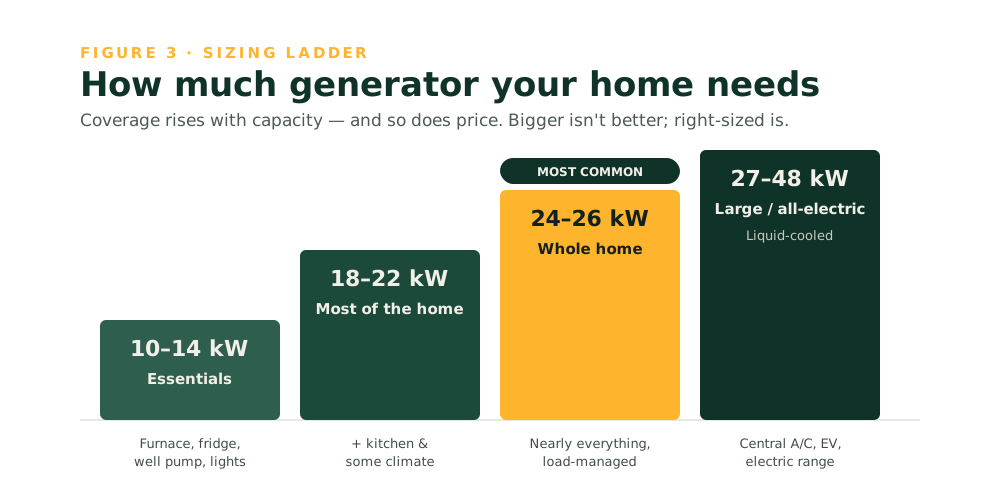
Figure 3. Coverage rises with capacity — the 24–26 kW “whole home” tier suits most homes.
In Washington, heat is the load that matters most. Many homeowners assume a gas furnace keeps working in an outage. It won’t on its own: the blower, ignition, and thermostat all run on electricity. During a multi-day winter outage — the kind Western Washington actually gets — keeping the furnace running is often the entire point. If you’re sizing for the Northwest, size for heat first.
Fuel in Washington: natural gas vs. propane
The fuel decision affects both your upfront cost and what you’ll pay every time the generator runs.
| Natural gas | Propane | |
|---|---|---|
| Availability in WA | Widely available in cities and suburbs (e.g., Puget Sound Energy, Cascade Natural Gas) | Common for rural homes without a gas main |
| Supply during an outage | Effectively unlimited — piped continuously | Limited to your tank; must be refilled |
| Running cost | Lowest of the two | Higher per hour of run time |
| Upfront cost | Gas-line connection from the meter | Tank purchase or lease, plus placement/pad |
| Best fit | Homes already on natural gas | Homes with no natural-gas service |
HEAD TO HEAD — Which fuel wins?
If you already have natural gas: it almost always wins — lower running cost, and an unlimited supply you never have to think about mid-storm.
If you’re rural and off the gas main: propane is your answer, and a dual-fuel-capable generator keeps your options open.
The deciding question isn’t preference — it’s whether a gas line already reaches your home.
As a planning figure, running a whole-house generator costs roughly $30–$170 per day of continuous use, depending on size and fuel, with natural gas at the lower end. During a typical Northwest outage you won’t run it continuously — but it’s the right way to think about a long event.
Permits, inspections, and code in Washington
This is where a local guide earns its keep, because Washington’s permitting picture is specific — and skipping it is one of the most expensive mistakes a homeowner can make.
AT A GLANCE
Expect two permits (a state electrical permit through L&I and a local mechanical permit), two inspections, mandatory 5-ft clearances, and seismic anchoring — a Washington-specific requirement most national guides skip.
A permanent standby generator is not a plug-in appliance. It is hard-wired into your electrical service and connected to a fuel line, and Washington regulates both. For a typical residential installation, expect:
- A state electrical permit through the Washington State Department of Labor & Industries (L&I). When you hire a contractor, they pull the permit for their work.
- A local mechanical (and sometimes building) permit from your city or county for the fuel connection and installation. Requirements vary — Seattle, Bellevue, Issaquah, and unincorporated county areas each run their own process.
- Setback and clearance rules. Where the manufacturer’s instructions don’t specify otherwise, jurisdictions commonly require at least 5 feet of clearance from openings into the home and from combustible materials.
- Seismic anchoring. Because Washington is seismically active, the generator generally must be anchored to its pad to code — a detail that matters here far more than in much of the country.
- Inspections. Plan on an electrical inspection (you’ll usually need to be home so the inspector can access your panel) and a mechanical inspection (typically performed at the exterior).
❝ The permit isn’t bureaucracy — it’s the paperwork that protects the investment. ❞
Why the permit is worth it. Three reasons, all financial. Insurance: an unpermitted installation can give an insurer grounds to deny a claim. Warranty: many manufacturers require professional, code-compliant installation to keep coverage valid. Resale: unpermitted electrical and gas work routinely surfaces during home inspections and can delay or derail a sale.
EDITOR’S NOTE
We’ve kept the permit specifics general on purpose. Requirements genuinely differ between, say, Pierce County and the City of Seattle, and we won’t print a number that’s precise-looking but wrong for your address. A good installer confirms your jurisdiction’s exact requirements before quoting — and that confirmation is itself a sign you’ve hired the right one.
The costs people forget: maintenance and lifetime ownership
The purchase price is only part of the picture. A standby generator has to start reliably on the worst night of the year, and that reliability comes from upkeep.
| Ongoing cost | Typical range | Frequency |
|---|---|---|
| Annual professional service (oil, filter, inspection) | $200 – $450 | Once a year |
| Battery replacement | $30 – $100 | Every 2–3 years |
| Fuel during an outage — natural gas | ~$30 – $90 per day of run time | As used |
| Fuel during an outage — propane | ~$60 – $170 per day of run time | As used |
A well-maintained whole-house generator lasts 15 to 30 years, or roughly 10,000–30,000 hours of run time. Reputable brands back their units with 5- to 10-year limited warranties. The practical takeaway: the cheapest system to buy is not always the cheapest to own.
❝ The cheapest system to buy is rarely the cheapest system to own. A well-installed, well-serviced unit wins over a decade. ❞
One number to remember. Budget a few hundred dollars a year for service and battery upkeep, plus fuel only when you actually use it. For most homeowners, that’s the true cost of keeping the lights on — predictable, modest, and far less than a freezer of spoiled food or a burst pipe from a furnace gone cold.
Is a whole-house generator worth it in Washington?
This is the honest question, and the honest answer is: it depends on your home, your situation, and what an outage actually costs you. But Washington’s outage pattern is worth understanding first.
AT A GLANCE
Our outages are driven by wind, ice, and falling trees — not hurricanes or heat — and they tend to last for days, in the heating season. That’s the scenario a generator is really bought against.
In November 2024, a bomb cyclone knocked out power to more than 600,000 customers across Western Washington, with gusts near 74 mph and some neighborhoods dark for days. It wasn’t an anomaly: a December 2006 windstorm left roughly 700,000 customers without power for multiple days, and a January 2012 storm caused an eight-day outage for hundreds of thousands. Tall trees and steep terrain leave the grid exposed, and major storms reliably produce multi-day outages — when losing power means losing heat.
❝ In Western Washington, the question isn’t whether the lights will go out for days. It’s whether your home is ready when they do. ❞
That’s the context a generator is really purchased against. For a household with young children, an elderly family member, a home medical device, a well that stops pumping without electricity, or a basement that floods when the sump pump dies, a multi-day winter outage isn’t an inconvenience — it’s a genuine problem. For others, a portable generator and a few coolers are a reasonable answer. Both can be right.
HEAD TO HEAD — Standby vs. portable
Standby — $9,000–$16,000 installed · starts automatically in seconds, even when you’re away · runs the home for days on natural gas · permitted and permanent.
Portable — $500–$2,500 · manual setup and refueling · powers a few essentials · no permit, no permanence.
A portable keeps a fridge cold and a phone charged. A standby keeps the house running. Choose by how much an outage actually costs your household.
EDITOR’S NOTE
If the honest answer for your home is “a portable and a plan,” we’re glad to have helped you get there. Not every home needs a standby generator, and a guide that pretends otherwise isn’t a guide — it’s an ad.
How to read a generator quote (so you can compare fairly)
Two quotes are only comparable if they cover the same scope. Before you sign, check that each proposal spells out:
AT A GLANCE — YOUR QUOTE CHECKLIST
Make/model/kW · transfer switch & amperage · itemized labor · fuel connection · both permits · any panel upgrade · startup & walkthrough · warranty & maintenance plan.
- The generator’s make, model, and kW rating — so you’re comparing equal capacity, not equal price.
- The transfer switch — included or separate, and its amperage.
- Installation labor — itemized, not buried in a lump sum.
- The fuel connection — gas-line work or propane tank, and who’s doing it.
- Permits and inspections — both the electrical and the mechanical permit.
- Any electrical panel upgrade — flagged before work starts, not discovered mid-job.
- Startup, testing, and a walkthrough — confirming the system runs before the crew leaves.
- The warranty and a maintenance plan — what’s covered, for how long, and what annual service costs.
A quote you can’t get over the phone. A trustworthy installer won’t give you a firm whole-house number sight-unseen, and that’s a good sign, not an evasion. The distance between your meters, the condition of your panel, and your home’s real load can only be assessed on site. A precise quote requires a site visit — be cautious of anyone who skips it.
What we’d do
This isn’t advice, and it isn’t our recommendation for your home — only an honest account of what we’d do if this were our own house, knowing what we know.
- We’d size for heat before convenience. In a Washington winter outage, a warm house matters more than a working dishwasher. We’d make sure the furnace was covered first and let the luxuries follow.
- We’d insist on permits, every time. Not because a rule says so, but because the permit is what protects the insurance claim, the warranty, and the resale years from now.
- We’d pay for the better installer before the bigger generator. The equipment rarely fails first; the installation does. Given the choice between a larger unit and a more careful crew, we’d take the crew.
- We’d buy the correct generator, not the largest one. An oversized unit costs more to buy, more to run, and protects nothing extra. We’d get a real load calculation and buy exactly what the house needs.
- We’d put the generator near the meters. If the layout allowed it, we’d accept a slightly less ideal spot in the yard to keep the wiring run short — and the bill lower.
- We’d get more than one quote, and read each one against the checklist above. Not to chase the lowest number, but to find the proposal that hides nothing.
❝ We wouldn’t do anything for your home that we wouldn’t do for our own. That’s the whole idea. ❞
Frequently asked questions
How much does a whole-house generator cost in Washington in 2026?
Most homeowners pay $9,000–$16,000 installed. Simple natural-gas installations can approach $7,000; larger or all-electric homes needing a liquid-cooled unit and possibly a panel upgrade can reach $20,000–$25,000+.
Does the installation really cost as much as the generator?
Often, yes. A reliable rule of thumb is that installation runs roughly equal to the equipment cost, because labor, fuel connection, the pad, and permits add up. The equipment-only price you see advertised is usually about half the finished cost.
Do I need a permit to install a generator in Washington?
Yes. Expect a state electrical permit through L&I and a local mechanical permit from your city or county, plus inspections. It’s required, and it protects your insurance, warranty, and resale value.
What size generator do I need?
It depends on whether you want essentials only (10–14 kW), most of the home (18–22 kW), the whole home with load management (24–26 kW), or a large/all-electric home (27 kW+, usually liquid-cooled). Proper sizing comes from a load calculation, not a square-footage guess.
Natural gas or propane — which is cheaper?
If your home already has natural gas, it’s usually the simpler and less expensive choice, with an effectively unlimited supply during an outage. Propane is the right answer for rural homes without gas service.
How long will it last, and what’s the upkeep?
A well-maintained unit lasts 15–30 years. Plan on annual service ($200–$450), occasional battery replacement, and fuel only when it runs.
Will my generator run my furnace?
Only if it’s sized to. A gas furnace still needs electricity for its blower and ignition, so keeping heat on during a winter outage is a sizing priority in Washington, not an afterthought.
Can I install it myself to save money?
No. A standby generator is hard-wired into your electrical service and fuel line, requires permits and licensed work in Washington, and improper installation can backfeed the grid, endanger utility crews, void your warranty, and fail inspection. This is a job for licensed professionals.
When you’re ready, start with a company that’s already met the standard
Most of the work in buying a generator isn’t choosing the equipment. It’s trusting whoever installs it.
That’s the part we exist to take off your plate. We don’t have to recommend anyone at all — and when we do, it’s because we’d be comfortable sending them to our own family’s home. If we wouldn’t trust a company with our own family, we won’t put their name in front of yours. So when we give you a name, you’re not starting from a search result; you’re starting from a recommendation that’s already been measured against that standard.
Today, the company we recommend serves Pierce County. As we earn the right to recommend companies in more of Washington, we’ll add them here — never before. If you’re in our coverage area and you’d like the name, the introduction is free, and there’s no obligation.
We’re an independent guide, not a contractor. We don’t install generators — we find the company we’d trust to, and introduce you. That independence is the whole point.
Related guides
- How a whole-house generator gets installed in Washington — the step-by-step of permits, placement, and what installation day looks like.
- What size generator does your home need? — a plain-language walkthrough of load calculations and sizing.
- Natural gas vs. propane for home backup power — choosing a fuel and what each costs to run.
- How we choose the companies we recommend — the standard every company is measured against before we’ll give you their name.
Sources & authorities: This guide synthesizes 2026 cost data and Washington-specific requirements from independent and authoritative sources, including Consumer Reports (generator testing and brand pricing); the National Fire Protection Association (NFPA 37 and NFPA 70 safety standards); the Washington State Department of Labor & Industries (electrical permitting and inspection); municipal building departments including Seattle SDCI, Bellevue, and Issaquah (local permit, setback, and seismic-anchoring requirements); national cost aggregators including HomeGuide, Angi, and HomeBuddy (installed-cost ranges); and Puget Sound Energy with regional news reporting (Western Washington outage data, the November 2024 bomb cyclone and historical windstorms). Figures are presented as typical 2026 ranges; your exact cost depends on your home and should be confirmed with an on-site assessment.
Last reviewed: 2026. Costs and code requirements change; we review this guide regularly to keep it accurate.